A China UV printer manufacturer quote can vary wildly for two machines built on the same platform size and the same class of printhead. Most buyers attribute that gap to manufacturer margin and order on the lowest number. That inference is wrong more often than it is right.
The gap comes from three places: the supplier’s identity (factory or trading company), the printhead configuration, and who carries after-sales liability. None of the three appear on a quotation. You have to ask. Choosing a UV printer manufacturer comes down to six verifiable dimensions, each with an action you can take immediately. If you are buying a UV printer from China, an email, a video call and one sample shipment are enough to complete all six.
The practices below are general industry procurement and factory-audit method, not an endorsement of any supplier. YOWILL’s specific configuration, lead times, warranty scope and pricing are quotation-specific.
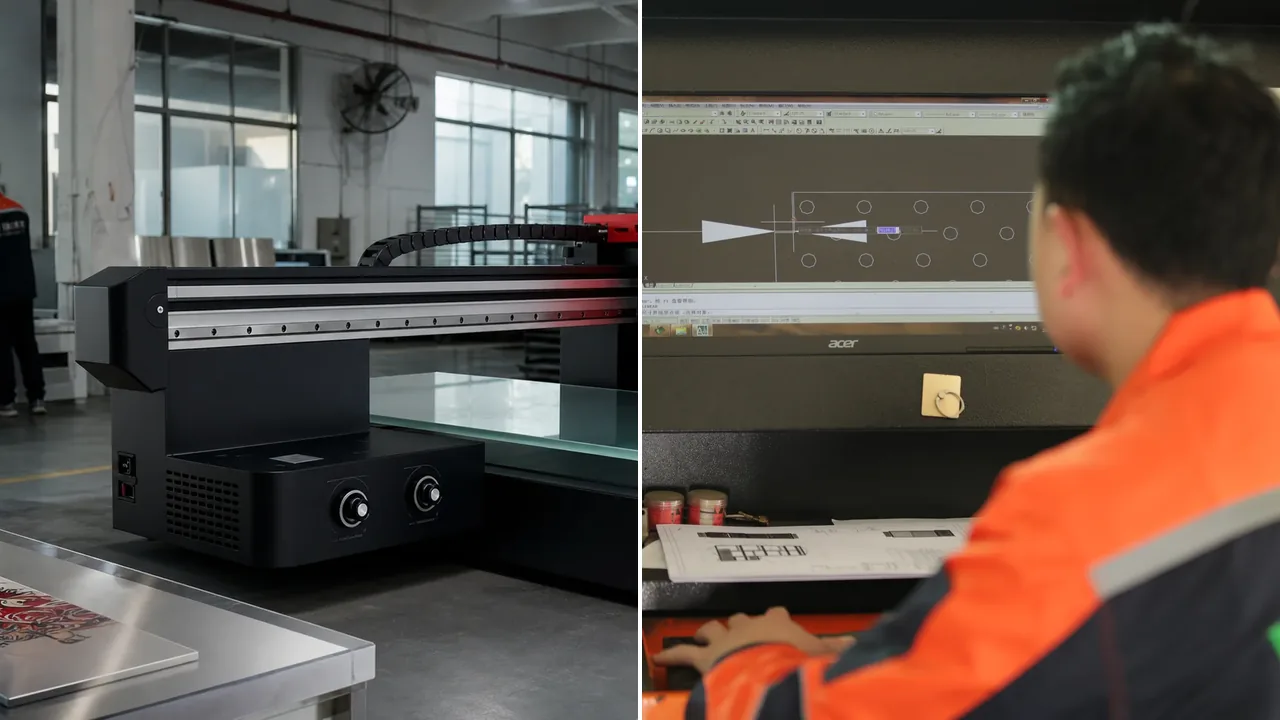
Left: YOWILL F6090 Industrial product image (composited unmodified). Right: candid shot of YOWILL workers.
Why after-sales terms now outweigh headline price
Three structural shifts have made simple price comparison the least effective filter.
The hardware has commoditised, so spec sheets no longer separate suppliers. Mainstream Chinese manufacturers draw printheads from the same pool of suppliers (Ricoh, Epson, Kyocera), converge on similar platform architecture, and concentrate on a handful of ink formulations. When everyone builds from the same core components, headline resolution and headline speed become less comparable — they reflect configuration choices more than machine quality.
The three cheapest quotes usually are not factories. A trading company carries no R&D or assembly cost and no component warranty liability, so it can quote lower. It is sometimes genuinely more flexible on small, non-standard orders, but its limits are clear: it cannot change configuration, its spare-parts chain is long, and when something fails you are dealing with an intermediary. The test is one question — can it modify configuration for your order?
“Made in China” is not a quality label; configuration and contract are. Treating country of origin as a quality variable is the most common misjudgement in equipment sourcing. Machines from the same production line differ in configuration mix (printhead count, platform size, attachments) and in after-sales contract terms (installation, training, spares, response). Origin sets a price band, not a quality floor.
Together these point to one conclusion: choose a manufacturer with a due diligence framework, not a price table. Here are its six dimensions.
1. Is this a factory, a trading company or an integrator?
Start by separating the three terms:
- Factory: owns the assembly line, can change configuration, can carry component warranty
- Trading company: no production line, re-quotes the catalogue, cannot change configuration
- Integrator: buys a complete machine and adds its own attachments (rotary fixtures, vision positioning, for example), so it has partial customisation capability
In most cases you do not need to reject any of the three. The UV printer factory vs trading company question matters because it decides what the supplier can actually commit to. You need to know which one you are buying from. For a first machine or a fully standard requirement, a trading company can respond faster. Once configuration changes and long-term spare parts are involved, a factory is the only party that can deliver.
Three checks you can finish in five minutes each:
- Ask for assembly-line and full-machine testing video, not photos of a finished-goods warehouse. A factory can show machines being assembled and run through testing; a trading company typically sends stacked cartons.
- Submit one non-catalogue configuration request — a different printhead count, a different platform size, a specific fixture. A factory returns a proposal and a feasibility judgement; a trading company’s standard answer is that it cannot be done.
- Request the spare-parts list and stock levels. A supplier that can hand over item numbers and inventory levels is usually actually supporting the machines it sells.
Choosing the machine configuration itself is a separate question — see the UV printer buying guide for that. Choosing the supplier is what this UV printer supplier due diligence framework covers.
2. How should I ask about printhead configuration, and who carries warranty?
The printhead is the machine’s most critical replaceable component and one of the main sources of quotation spread. UV printhead warranty liability is the item most often left vague. Printhead configuration and pricing are quoted per customer order, so nothing here lists prices — only what to ask.
Three things to pin down:
First, model and count. Asking “how many heads” gets you nothing useful. Get the specific model (Ricoh series, Epson F1080 or TX800, Kyocera series) and the specific count, and put both in a technical annex. Different models trade off resolution, speed and maintenance cost differently — the logic of that trade-off is in How to choose a UV printhead.
Second, original new head, pulled head or refurbished head. All three will run the machine, but they differ in service life and stability. This has to be stated in writing, not confirmed verbally.
Third, who carries warranty liability. The common arrangement is that the machine manufacturer carries printhead warranty and deals with the printhead brand internally; some operate under the printhead brand’s terms instead. Both work — the difference is whether you face one party or coordinate between two after a failure. This clause belongs in the contract; a verbal promise carries no weight in cross-border trade.
3. What has to be settled on overseas support and spare parts?
Cross-border equipment buying has one distinctive feature: when the machine breaks, the manufacturer is not in your city. That makes the actual value of after-sales terms potentially higher than the price difference. Four items need to land.
| # | Item | How specific the answer must be |
|---|---|---|
| 1 | Installation | Remote guidance or on-site? Included in the quote or billed separately? |
| 2 | Training | Remote, on-site or video course? How many operators covered? |
| 3 | Spare parts | Consumable and wear-part list, order lead time, air-freight emergency option |
| 4 | Response | Fault-response method and time limit, written into the contract |
The fourth is the one most often skipped. Most cross-border disputes are not about the machine; they are about the gap between what was agreed verbally and what the contract says. Once the machine is on site, use the UV printer maintenance checklist to set your own service rhythm.
4. My own substrate sample test — what are the five things to look at?
Spec sheets are reference material. UV printer sample testing on your own substrate is the decision input. Send the material you really produce on, and deliberately include your thinnest, thickest and hardest-to-adhere stock — that is the fastest way to surface problems.
Five evaluation items:
| # | Item | How to judge it |
|---|---|---|
| 1 | Adhesion | Cross-hatch test, fingernail scratch, bend — does ink come off? |
| 2 | White-ink opacity | Does it show through on clear or dark substrate? |
| 3 | Actual cycle time | Time it on your own artwork complexity; do not trust headline speed |
| 4 | Surface finish | Does matte, gloss or relief match your finished-product positioning? |
| 5 | Post-processing compatibility | Any problem after lamination, cutting or assembly? |
The third is the item most often skipped and the one that most affects the cost case. Headline speed usually comes from continuous printing of a simple pattern, while your orders are mostly complex artwork, short runs and frequent changeovers — actual cycle time can be a fraction of the headline figure. Adhesion and white ink both come down to matching ink to substrate; that selection logic is covered in How to choose UV ink and the white ink printing guide.
Agree who pays for sample production and return freight before you ship anything. Small disputes here slow the whole procurement down.
5. How do I settle payment, acceptance and logistics terms?
Payment structure. The common pattern is a deposit plus balance, with the balance tied to pre-shipment or post-arrival milestones. The exact ratio is negotiated per order, but hold one line: never accept full prepayment with no acceptance milestone.
Acceptance criteria. Write the section 4 sample results directly into the acceptance basis — adhesion, white-ink opacity, actual cycle time. That removes any argument about whether the machine passed once it arrives.
Trade terms. FOB, CIF and EXW shift risk and cost at different points. State explicitly whether the port or the door is covered by whom, and avoid vague phrasing like “shipped to you”.
Logistics and customs. The customs code for a UV printer is 8443.32 (inkjet printing machinery). Destination duties and VAT follow local tariff schedules — cost them in up front rather than discovering them at the port.
Compliance documents. When equipment ships to a specific market, request the relevant documents from the manufacturer according to that market’s import requirements. Requirements differ by market and local regulations govern. Only one action matters here: the documents must carry a reference number you can verify — a screenshot alone is not verification.
6. Turn the findings into one comparison table
The six inputs live in videos, emails, samples and contract drafts. Without a table you decide on impression, and impression is usually dominated by whichever supplier you spoke to first.
| Dimension | Candidate A | Candidate B | Candidate C |
|---|---|---|---|
| Identity (factory / trading / integrator) | |||
| Printhead model × count + warranty liability | |||
| Overseas install / training / spares | |||
| Sample results (adhesion / opacity / cycle time) | |||
| Payment and acceptance terms | |||
| Compliance documents | |||
| Total cost of ownership | |||
| Overall score |
Decision rule: score three to five candidates, then keep only one or two for contract negotiation. If you have more than five in play, your screening criteria are probably still undefined — go back and write them down first.
Do not fill the last row with the machine price alone. Freight, duties, sample cost, spare-parts stock and after-sales cost all belong there — plenty of “cheapest” quotes reverse on that line.
FAQ
How do I tell whether a Chinese UV printer supplier is a factory or a trading company? Ask for assembly-line and full-machine testing video, submit one non-catalogue configuration request to see whether a proposal comes back, and request a spare-parts list with stock levels. A factory can change configuration and carry component warranty; a trading company usually quotes the catalogue only.
Is printhead warranty carried by the manufacturer or by the printhead brand? Get it in writing. The common arrangement is that the machine manufacturer carries it and deals with the printhead brand internally; some operate under the printhead brand’s terms instead. Both work — the difference is whether you face one party or coordinate between two when something fails.
What should I send for a sample test when buying a UV printer from China? Send the substrate you actually produce on, and deliberately include your thinnest, thickest and hardest-to-adhere material plus a real artwork file. Test adhesion, white-ink opacity, actual production cycle time and post-processing compatibility.
Can Chinese UV printer manufacturers provide overseas installation and training? Most provide remote installation guidance and operator training; on-site visits depend on the manufacturer and the order. The critical step is putting this into the contract — headcount, spare-parts lead time and fault-response terms — because a verbal promise carries no weight in cross-border trade.
Which compliance documents do I need to import a UV printer? Request the documents your destination market requires from the manufacturer. Requirements differ by market and the local regulations govern. The one action that matters here: the documents must carry a reference number you can verify — a screenshot alone is not verification.
Price is the starting point of screening, not the finish line. Run the six dimensions and you will hold a comparison table that supports a decision, rather than a list of numbers.
To match equipment to your target market and output, see the YOWILL F6090 Industrial (600 × 900 mm platform, up to 300 mm print height), F1613 Industrial (1600 × 1300 mm) and F2513 Max (2500 × 1300 mm) model pages, covering the main platform sizes for signage and panel processing; for crystal labels and premium gift labels see the UDTF-320 Pro and UDTF-620 Industrial. YOWILL is a UV printing equipment manufacturer based in Shenzhen with a technical team of more than ten years in the digital printing industry, providing remote installation guidance, operator training and spare-parts supply. Contact sales for configuration and sample-test advice against your substrate and target market.
Frequently Asked Questions
How do I tell whether a Chinese UV printer supplier is a factory or a trading company?
Ask for assembly-line and full-machine testing video, submit one non-catalogue configuration request to see whether a proposal comes back, and request a spare-parts list with stock levels. A factory can change configuration and carry component warranty; a trading company usually quotes the catalogue only.
Is printhead warranty carried by the manufacturer or by the printhead brand?
Get it in writing. The common arrangement is that the machine manufacturer carries it and deals with the printhead brand internally; some operate under the printhead brand's terms instead. Both work — the difference is whether you face one party or coordinate between two when something fails.
What should I send for a sample test when buying a UV printer from China?
Send the substrate you actually produce on, and deliberately include your thinnest, thickest and hardest-to-adhere material plus a real artwork file. Test adhesion, white-ink opacity, actual production cycle time and post-processing compatibility.
Can Chinese UV printer manufacturers provide overseas installation and training?
Most provide remote installation guidance and operator training; on-site visits depend on the manufacturer and the order. The critical step is putting this into the contract — headcount, spare-parts lead time and fault-response terms — because a verbal promise carries no weight in cross-border trade.
Which compliance documents do I need to import a UV printer?
Request the documents your destination market requires from the manufacturer. Requirements differ by market and the local regulations govern. The one action that matters here: the documents must carry a reference number you can verify — a screenshot alone is not verification.
6-step due diligence on a Chinese UV printer manufacturer
- Shortlist 3-5 candidates and mark the factory or trading evidence
- Request printhead model, count and warranty liability in writing
- Confirm the exact scope of overseas install, training and spares
- Send your own substrate to test adhesion, opacity and cycle time
- Settle payment ratio, acceptance criteria, trade terms and documents
- Score the comparison table and keep 1-2 for contract negotiation
Share this article