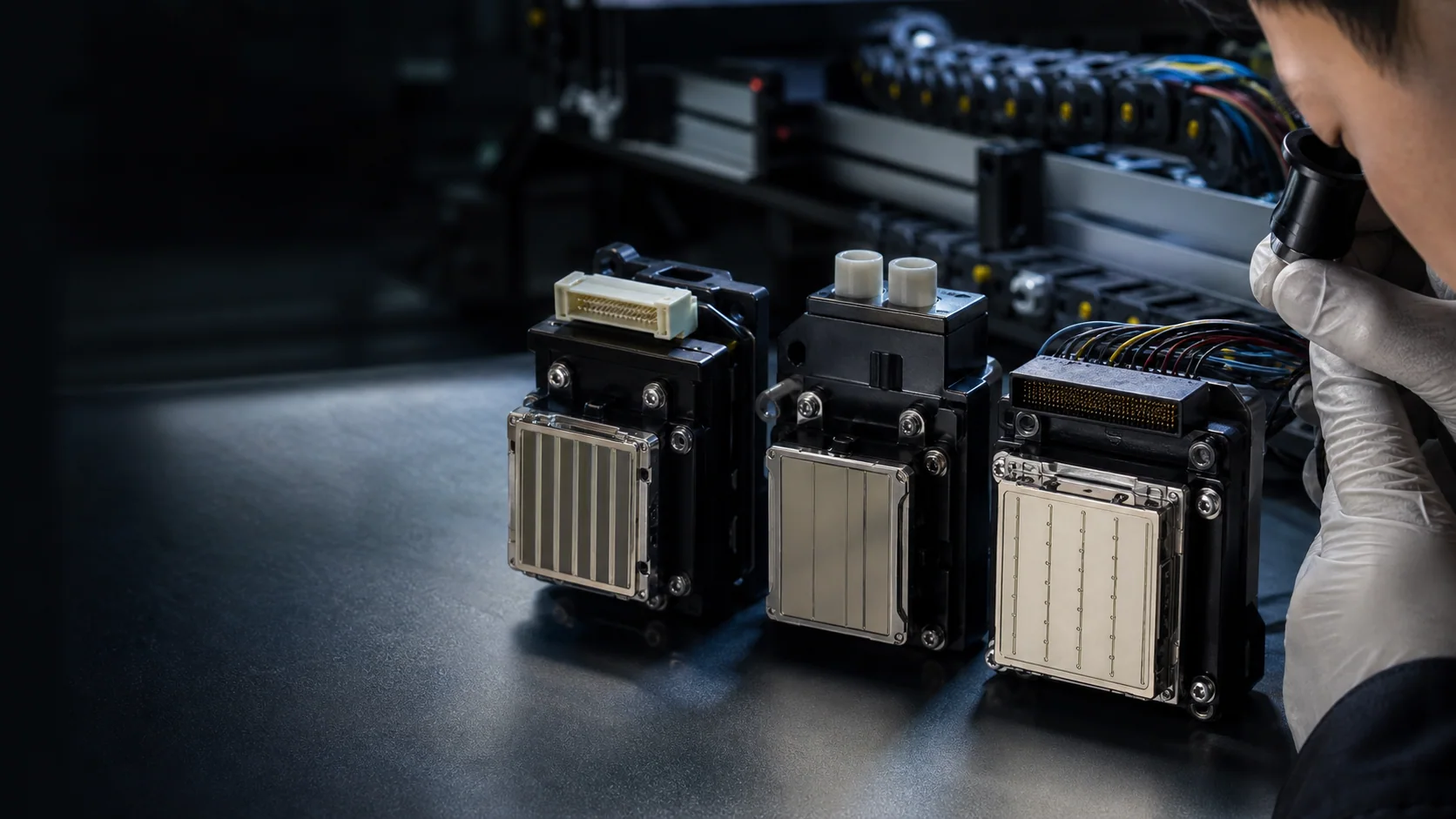
In the previous buying guide we mentioned: the print head determines the precision, speed, and stability of a UV printer. This article lays out the five mainstream print head solutions side by side — the Epson TX800 that YOWILL standardizes on across its main product line, the XP600 as a legacy compatibility option, the I3200 for high-precision applications, plus Ricoh G5/G6 and Kyocera as industrial references — to help you understand why different price points use different print heads.
Five Major Print Head Solutions Overview
| Parameter | Epson XP600 | Epson TX800 | Epson I3200 | Ricoh G5 | Ricoh G6 | Kyocera |
|---|---|---|---|---|---|---|
| Type | Piezoelectric | Piezoelectric | Thin Film Piezo | Layered Piezo | Layered Piezo | Thin Film Piezo |
| Maximum Resolution | 1440dpi | 1440dpi | 2880dpi | 1200dpi | 1200dpi | 1200dpi |
| Droplet Size | 3.5pl - 12pl | 3.8pl - 18pl | 3.5pl - 20pl | 7pl - 35pl | 5pl - 30pl | 4pl - 30pl |
| Nozzle Count | 1080 (6 rows x 180) | 2400 (6 rows x 400) | 3200 (8 rows x 400) | 1280 | 1280 | 2656 |
| Max Drive Frequency | 30kHz | 36kHz | 43kHz | 50kHz | 60kHz+ | 80kHz+ |
| Material Temperature Control | Not required | Not required | Not required | Required (40-50°C) | Required (40-50°C) | Required |
| Lifespan | 8-12 months | 12-18 months | 6-12 months | 12-24 months | 18-30 months | 24-36 months |
How Good Is the Epson TX800 Printhead: Precision, Output and Maintenance Cost
Technical Background
The Epson TX800 is the most common print head in the desktop, small-format and mid-format UV printer market in China. It builds on Epson’s mature MicroPiezo technology and is electrically and mechanically optimized for UV flatbed printing. YOWILL standardizes on the TX800 across its core product line — A4UV, 3360UV, 5060UV, 6040UV, 6090UV, 2513UV, 1613UV, and the wall printer.
Real-World Performance
Precision: With a 3.8pl minimum droplet at 720dpi native resolution, the TX800 delivers clean gradients and near-invisible dot structure on phone cases, medals, small crafts and leather customization.
Speed: Single-head output is approximately 2-3㎡/h (varies by pass count). Multi-head configurations scale output significantly — YOWILL’s 6040UV with three TX800 heads reaches 4-6㎡/h, and the 2513UV with four heads delivers 8-12㎡/h.
Stability: The mid-sized nozzle diameter is more forgiving than the I3200 on ink cleanliness and ambient temperature (recommended 20-28°C). Daily auto cleaning and a cleaning-fluid soak after 3+ idle days are sufficient.
Lifespan: Approximately 12-18 months under normal use. Ultrasonic cleaning can recover partially clogged heads but carries some risk.
Cost: Low unit price and controllable replacement cost. Combined with precision, grayscale, throughput and lifespan, the TX800 is the lowest entry-barrier and overall strongest head in the current UV printing market — which is exactly why YOWILL uses it as its entry-level standard.
Usage Notes
- Use only certified UV ink — low-quality ink corrodes the internal channels
- Maintain ambient temperature 20-28°C, humidity 40-60%
- Run the auto cleaning cycle at every startup
- For idle periods over 3 days, soak the head with dedicated cleaning fluid
Is the Epson XP600 Still Worth Using? Legacy Compatibility Scenarios
Technical Background
The XP600 is a simplified head in the same Epson family, primarily aimed at legacy compatibility with existing XP600-equipped machines or specific process requirements. YOWILL offers the XP600 as an option on the A4UV and 6090-Vision models — it is no longer the entry-level default.
Real-World Performance
Precision: With a 3.5pl minimum droplet and 720dpi native resolution, the XP600 looks acceptable on paper. In practice, only 4 grayscale levels (vs 8 on the TX800) and only 1,080 nozzles (vs 2,400 on the TX800) make light gradients, fine detail and single-head throughput clearly weaker than the TX800.
Speed: Single-head output is approximately 1.5-2.5㎡/h. Multi-head configurations compensate for the speed gap.
Stability: Simple structure, low maintenance demands — the easiest option for first-time UV printer operators.
Lifespan: Approximately 8-12 months, somewhat shorter than the TX800.
Cost: Unit price is similar to or slightly higher than the TX800 — this is the core reason the XP600 has lost its position as the entry-level default.
Usage Notes
- Same maintenance routine as the TX800
- Only 4 grayscale levels (vs 8 on the TX800) and 1,080 nozzles (vs 2,400 on the TX800); light gradients and single-head throughput are both clearly weaker than the TX800
- Current market price is similar to or slightly higher than the TX800, so it is no longer the cheapest option
- Still useful for compatibility with legacy XP600-equipped machines or specific processes
Epson I3200: High-Precision Option
Technical Background
The I3200 (also called 4720/DX11) is the flagship head of Epson’s PrecisionCore Thin Film Piezo (TFP) family, with higher nozzle density for precision-critical applications. YOWILL offers the I3200 as a configuration option on the 6090-Vision, A3-DTF and UV-DTF product lines.
Real-World Performance
Precision: The I3200’s standout strength. 3,200 nozzles with 3.5pl droplets and up to 2880dpi resolution deliver the best photo-grade detail, fine text and PCB marking in this comparison.
Speed: Single-head output is approximately 2-4㎡/h. Faster than the XP600, comparable to the TX800.
Stability: The precision structure demands more frequent maintenance — the small nozzle diameter clogs more easily. Daily cleaning is mandatory, and cleaning-fluid soak is recommended for extended idle periods.
Lifespan: Approximately 12-18 months.
Cost: Higher unit price than the TX800.
Usage Notes
- Use only certified ink
- Maintain ambient temperature 20-28°C
- Run cleaning cycles on a regular schedule
Ricoh G5 / G6: Industrial Reference
Technical Background
Ricoh’s industrial-grade piezoelectric heads are designed for large-format and industrial production. The G5 is the previous-generation mainline, while the G6 (post-2020) brings clear improvements in lifespan and stability. YOWILL does not standardize on Ricoh heads in its core line, but the 6090-Vision offers a G5i option as a reference.
Real-World Performance
Precision: Less fine than Epson, but more than adequate for industrial applications. The gap is small on outdoor advertising and signage; on small-item high-precision work, Epson has a clear edge.
Speed: The wider head format (54mm vs 33mm) plus higher drive frequency gives Ricoh a higher per-head throughput than Epson, which is why industrial-grade machines often favor Ricoh when output matters more than ultimate detail.
Stability: Ricoh’s key strength is durability. The G5 lasts 2-3 years under normal maintenance, the G6 even longer. Larger nozzle diameter tolerates ink particles better, with significantly lower clog rates than Epson.
Lifespan: G5 about 2-3 years, G6 3+ years.
Cost: Higher unit price, but longer service life means the total cost of ownership can be lower than Epson’s.
G5 vs G6
The G6 improves on the G5 with: smaller droplets (5pl vs 7pl) for better precision, upgraded internal coating for better corrosion resistance, higher drive frequency for 10-15% more speed, and a scratch-resistant nozzle plate. If budget allows, go straight to G6.
Kyocera: Ultra-High-Speed Industrial Solution
Technical Background
Kyocera heads are the premium tier in industrial inkjet, known for ultra-high speed and ultra-long service life. They are also the most expensive.
Real-World Performance
Kyocera’s key advantage is speed: an 80kHz drive frequency and a 108mm wide-format head mean a single Kyocera head can replace 3-4 Epson heads in throughput. This fits very-high-volume industrial production lines.
Drawbacks are equally clear:
- Very high unit price per head
- Complex control and driver requirements — dedicated boards and software
- High service and replacement cost
- Limited adoption in the Chinese UV printer market
Most buyers do not need to consider Kyocera.
Side-by-Side Comparison
| Dimension | XP600 | TX800 | I3200 | Ricoh G5/G6 | Kyocera |
|---|---|---|---|---|---|
| Precision | ★★★☆ | ★★★★ | ★★★★★ | ★★★☆ | ★★★☆ |
| Speed | ★★ | ★★★ | ★★★ | ★★★★ | ★★★★★ |
| Stability | ★★★★ | ★★★★ | ★★★ | ★★★★★ | ★★★★★ |
| Lifespan | ★★★ | ★★★★ | ★★★ | ★★★★★ | ★★★★★ |
| Maintenance | Low | Low | High | Low | Low |
| Best For | Legacy compatibility | General commercial | High-precision commercial | Industrial batch | High-speed production line |
Core Advantages of the TX800 and XP600
YOWILL chose the TX800 as its mainstream head and the XP600 as the legacy compatibility option because both Epson heads deliver four clear advantages in UV printing scenarios:
1. Sufficient precision at a lower total cost
The TX800’s 3.8pl and the XP600’s 3.5pl droplets already cover the majority of commercial needs — phone cases, medals, small crafts, leather customization. In the current UV printing market, the TX800 is the overall stronger of the two Epson heads; compared to the I3200, both Epson heads have a significantly lower total cost of ownership, and the visible quality gap in most real-world applications is negligible.
2. Lower maintenance burden
Both heads have larger nozzle diameters than the I3200, making them more forgiving on ink cleanliness and ambient temperature. In practice this means:
- Less frequent cleaning cycles, saving operator time
- Easier recovery after extended idle periods — heads are less prone to permanent clogs
- A mature domestic supply chain for compatible inks, keeping parts and service costs low
3. Flexible configuration across formats
The TX800 can be deployed in 1, 2, 3 or 4 head combinations, covering everything from A4 desktop units to 2513 industrial flatbeds with the same head model. For buyers this means:
- Parts are interchangeable across models — a single SKU covers multiple machines
- The upgrade path is straightforward — moving from the 3360UV single-head to the 6040UV triple-head keeps the same head model
4. Best total cost of ownership
The I3200 offers slightly higher precision but requires more frequent maintenance and has a shorter service life. Ricoh G5/G6 heads last longer but cost significantly more per head than the TX800. For small and mid-sized buyers, the TX800 and XP600 hit the sweet spot across availability, affordability and maintainability.
When are the TX800 and XP600 not enough?
- Industrial 24/7 continuous production at maximum throughput — the TX800 still works, but plan on the 4-head configuration (2513UV, 1613UV)
- Extreme precision requirements (PCB marking, ultra-fine patterns) — choose the I3200
- Vision-alignment printing, UV DTF and other specialized processes — choose the flexible-configuration models (6090-Vision, DTF series)
YOWILL Accepts Full Print Head Customization
Every YOWILL mainstream model (A4UV, 3360UV, 5060UV, 6040UV, 6090UV, 2513UV, 1613UV, wall printer, 6090-Vision, A3-DTF / 320-DTF / 620-DTF) supports full customization of print head type, head count, ink configuration, bed size and optional features:
- Print head type: XP600, TX800, I3200, G5i, F1080, TX600 and others — covering every segment from entry-level to industrial
- Head count: 1, 2, 3 or 4 heads, matched to throughput and budget
- Ink configuration: CMYK, CMYK + White, CMYK + White + Varnish, etc.
- Bed size: from 200 x 300mm desktop to 2500 x 1300mm industrial large format
- Optional features: rotary axis, vision alignment, production-line interface, custom fixtures
Whether you are running small-batch customization or industrial-scale production, have special material requirements, or prefer a specific print head brand, every parameter can be configured to your order. This is the biggest difference between YOWILL and brands that sell fixed configurations only — we sell solutions, not products.
YOWILL’s Head Selection Logic
YOWILL matches print head configuration to model and application:
| Model | Print Head | Count | Why this configuration |
|---|---|---|---|
| A4UV | TX800 | 1 | Compact desktop, entry-level standard head |
| 3360UV | TX800 | 1 | Entry-level commercial, value-driven |
| 5060UV | TX800 | 2 | Dual-head entry industrial, balanced output |
| 6040UV | TX800 | 3 | Multi-head for higher output, cost-controlled |
| 6090UV | TX800 | 3 | Commercial color + white + varnish workflow |
| 2513UV / 1613UV | XP600 / I3200 / TX800 / G5i etc. | 2-4 | Industrial large format, flexibly configured by output, effect and budget |
| Wall printer | TX800 | — | Field deployment requires high stability |
| 6090-Vision | XP600 / 1600 / I3200 / G5i | 2-4 | Flexible configuration by vision-alignment precision |
| A3-DTF / 320-DTF / 620-DTF | TX600 / XP600 / I3200 / F1080 / TX800 | 2-4 | Configured by output, effect and budget |
Why YOWILL standardizes on the TX800:
- Strong balance of precision and cost — 3.8pl droplets at 720dpi satisfy most commercial needs
- Moderate maintenance demands — more forgiving than the I3200, more affordable than Ricoh
- Mature accessory and compatible-ink supply chain in China — easier service and replacement
- Flexible head-count combinations — 1, 2, 3 or 4 heads cover the full range from A4 to 2513
The configuration logic maps cleanly to user applications:
- Desktop (A4UV): TX800 standard, focused on entry barrier
- Entry commercial (3360UV, 5060UV): TX800 single or dual head, capable and cost-effective
- Mid commercial (6040UV, 6090UV): TX800 triple head, balancing precision and output
- Industrial (2513UV, 1613UV): TX800 / I3200 / G5i multi-head options, flexibly configured by output, precision and budget
- Flexible-configuration models (DTF series, 6090-Vision): select head per specific application
Selection Guide
Choose TX800 if:
- You focus on small-item high-precision printing (phone cases, small signs, gifts, medals)
- Your order volume is moderate and you need a balance of precision and stability
- You want controllable maintenance cost
- You want long-term stable accessory supply
Consider XP600 if:
- Your existing equipment or process relies on the XP600 and you need to stay compatible
- You do not need top-tier precision or speed and want interchangeable parts with legacy machines
- Note: the current XP600 market price is similar to or slightly higher than the TX800, so it is no longer the cheapest entry option
Choose I3200 if:
- You need extreme precision (PCB marking, ultra-fine patterns)
- You accept more frequent head maintenance
- Your budget allows the higher unit cost
Choose a flexible-configuration model (DTF series, 6090-Vision) if:
- Your business spans multiple materials and applications
- You need to switch head configurations based on the order
YOWILL does not currently standardize on Ricoh G5/G6 or Kyocera in its core product line. While both deliver long life and high stability, the unit price, ink requirements and service complexity push the total cost of ownership higher than most small and mid-sized buyers can absorb. For industrial-scale batch production, the YOWILL 2513UV and 1613UV with multiple TX800 heads already cover the majority of scenarios.
Related Guides
- How to Choose UV Ink: Material, Flexibility and Adhesion — Printhead and ink pairing
- UV Printer Maintenance Checklist — Printhead lifespan depends on daily maintenance
- UV Printer Buying Guide — Where the printhead sits in the full machine selection
Frequently Asked Questions
Which UV printer printhead is best?
There is no absolute 'best' — only the best fit for your work. Epson's TX800 is the strongest all-around entry-level head, covering most commercial work (phone cases, medals, small crafts, leather). The I3200 is the high-precision commercial option for PCB marking and ultra-fine artwork. Ricoh G5/G6 are industrial high-volume options with long life but higher unit cost. All specific configurations and pricing are quoted per-customer.
Should I choose the TX800 or the I3200?
Order profile drives the choice. For small-piece fine print (phone cases, small signs, leather) with mid-volume orders, the TX800 balances precision, maintenance cost and total cost — YOWILL's mainstream machines standardize on it. For extreme precision needs (PCB marking, ultra-fine artwork) with acceptance of more frequent head maintenance, choose the I3200.
How often does a printhead need replacement?
Under normal use with regular maintenance, Epson TX800 lasts 12-18 months, I3200 lasts 12-18 months, Ricoh G5 lasts 2-3 years. Lifespan depends heavily on ink cleanliness, ambient temperature and humidity (recommended 20-28°C, 40-60% RH) and daily cleaning frequency.
What if the printhead is clogged?
Light clogs respond to the machine's built-in head-cleaning program. Moderate clogs need an ultrasonic cleaner with dedicated cleaning fluid. Severe clogs essentially require head replacement. Running the head-cleaning program at every startup — not waiting for full clogs — is the key to extending life.
What ink compatibility does the printhead require?
Only certified UV ink. Inferior ink corrodes the head internals, shortens life and degrades color. Domestic compatible ink supply chains are mature, but pick suppliers that publish complete TDS/SDS documentation and offer after-sales support.
5-step UV printhead selection workflow
- Define the main product's maximum size, precision requirement and daily output
- Compare TX800, I3200 and XP600 on precision and grayscale capability
- Evaluate maintenance capability and head-replacement budget
- Determine head count by ink requirements (white ink / varnish)
- Match a YOWILL mainstream machine to the order profile for head configuration