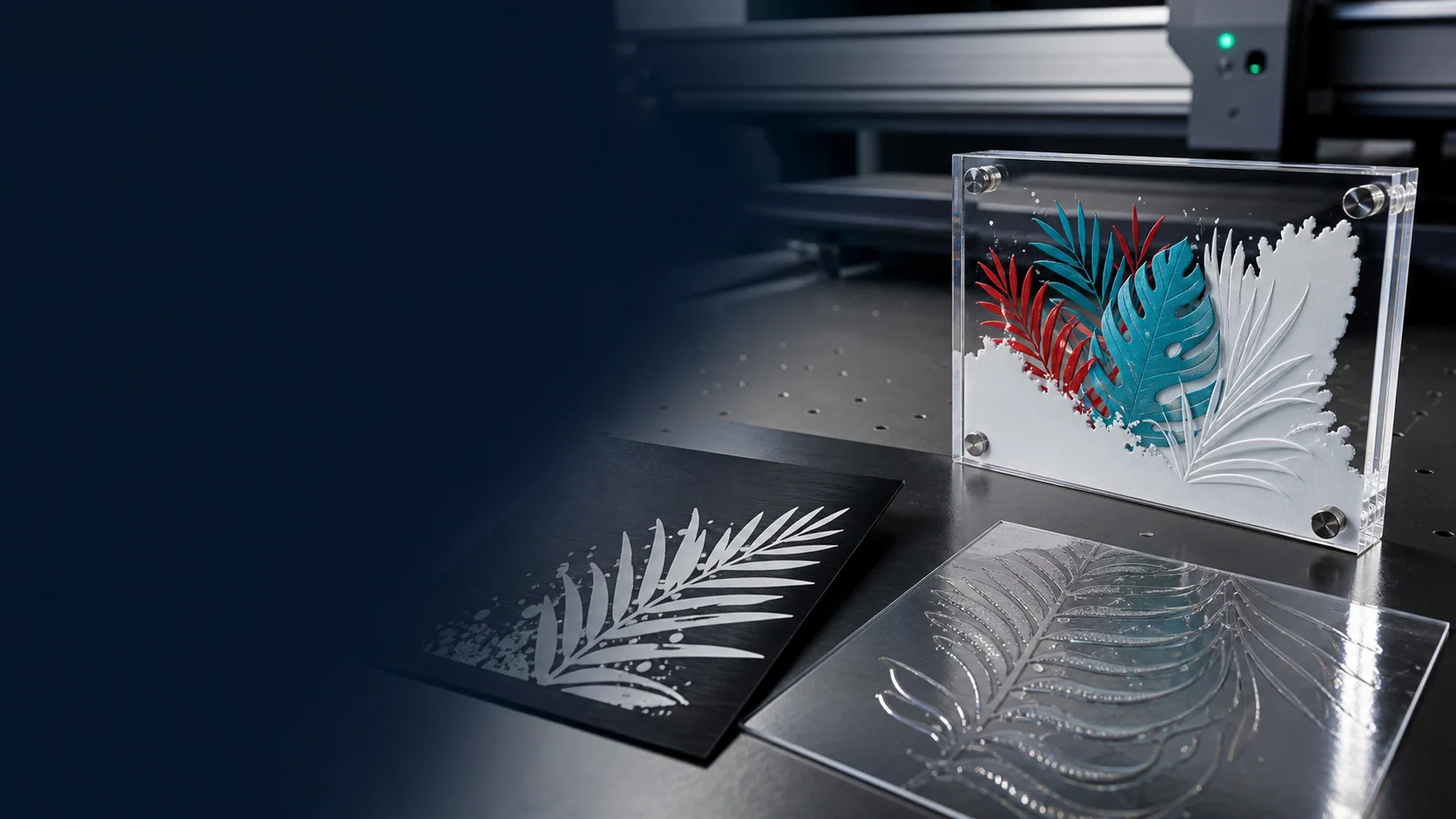
White ink is the most technically demanding ink type in UV printing — bar none. Its core challenge is this: the density of white pigment (typically titanium dioxide TiO2) is far higher than the pigments used in color inks, making white ink more prone to sedimentation and nozzle clogging. A dedicated ink circulation system is required to maintain stability.
But white ink is also where UV printing delivers its highest commercial value. Without white ink, UV printing on dark materials is impossible. With it, the entire custom printing market opens up.
Four Core Uses of White Ink
1. Underprint
A layer of white ink is printed first on transparent or dark materials as a base, followed by color printing on top.
Without white underprint: color inks on transparent materials (acrylic, glass) look like a translucent film, with extremely low color saturation. With white underprint: colors appear fully saturated, matching the look of print on white paper.
2. Masking / Spot White
On opaque dark materials (dark metal sheets, dark plastics, dark leather), white ink serves as a masking layer that covers the dark background, allowing color inks to show their true hues.
Tip: The thickness and coverage of the white masking layer directly affect the brightness of the color layer. Adjust the number of white ink passes based on how deep the material color is.
3. Highlight / Accent
On white or light-colored materials, white ink can be used as a highlight layer or decorative element.
For example: printing a white ink pattern on transparent acrylic creates a frosted / semi-translucent effect with a highly designed look.
4. Embossing
Stacking multiple layers of white ink creates a raised, three-dimensional effect. Laying down 3-5 layers of white ink produces a noticeable height difference, ideal for tactile signage, braille, and brand logos.
White Ink Circulation System: Why It Matters
The pigment particles in white ink have a density of 4.23 g/cm3 (titanium dioxide), while the organic pigments in color inks are only 1.3-1.8 g/cm3. If white ink sits static in the tubing for more than 10-15 minutes, the pigment begins to settle, leading to:
- Uneven ink concentration — unstable color output
- Sediment buildup inside the print head — nozzle clogging
- Significant ink waste from flushing
Circulation System Design Requirements
| Feature | Requirement | Reason |
|---|---|---|
| Circulation frequency | Continuous circulation, intervals no longer than 5 minutes | Prevents pigment settling |
| Short, straight tubing | Minimize bends and long tube runs | Reduces sedimentation risk |
| Agitation mechanism | Stirring or shaking mechanism inside the ink tank | Keeps the entire tank evenly mixed |
| Temperature control | Optimal printing temperature 35-45C | Lowers viscosity, improves flow |
When choosing equipment, the white ink circulation system is a key differentiator. Low-cost machines typically lack an independent circulation system, significantly increasing the risk of issues during extended white ink printing. YOWILL’s mid-range and above models (3360UV, 6040UV, 6090UV) come standard with an independent white ink circulation system.
What Are White Ink Print Quality Standards?
| Criterion | Good | Average | Poor |
|---|---|---|---|
| Whiteness | Pure white, no show-through | Slightly yellowish or grayish | Noticeably yellow |
| Opacity | Single pass covers dark substrate | Requires 2-3 passes | Still shows through after multiple passes |
| Fine detail | No graininess | Slight grainy feel | Clearly rough |
| Edge sharpness | Clean lines, no feathering | Slight ink spread | Obvious bleeding |
| Adhesion | No peel-off in crosshatch test | Minor flaking | Large-area peeling |
Business Value of White Ink
1. Dark Phone Case Customization (Low Barrier, High Margin)
Market price 80-150 RMB per case, material cost 10-20 RMB, ink cost 2-5 RMB, gross profit 55-130 RMB per case.
- 10 cases per day: daily gross profit 550-1,300 RMB
- Payback period: roughly 1-3 months for an A3-class printer
2. Transparent Acrylic Signage (High-Value Enterprise Clients)
Acrylic signage sells for 80-200 RMB per piece, with white ink underprinting as the core process — without white ink, color printing on transparent acrylic is simply not possible.
Enterprise clients have high reorder rates and rarely switch suppliers once confirmed. This is the classic “build a reputation, live on repeat orders” market.
3. Personalized Dark-Color Gifts (Differentiated Competition)
Dark leather notebook personalization, black gift boxes, dark liquor bottle engraving alternatives — these are categories with fewer competitors, higher per-order value, and strong customer loyalty.
Common White Ink Usage Issues
- Uneven white ink surface: Check print head height and platen levelness.
- Insufficient white ink opacity: Increase the number of print passes, or check whether the ink has expired.
- White ink appears yellow: Over-curing — reduce UV lamp power or increase print speed.
- Nozzle clogging: Verify the circulation system is running properly, then perform a head cleaning.
- Poor white ink adhesion: Confirm the material was properly pretreated, or switch to a white ink formulation suited for that material.
YOWILL’s mid-to-high-end models feature an independent white ink circulation system plus automatic agitation, reducing the difficulty of white ink usage at the hardware level. The real-world result is: white ink nozzle clogging reduced by approximately 70%, ink waste reduced by approximately 50%.
Related Guides
- How to Choose UV Ink — Ink flexibility and substrate matching
- Is a Small UV Printing Business Right for You? — How white-ink configuration affects per-piece margin
Frequently Asked Questions
Can I skip the white-ink circulation if I only print white ink once?
No. Without circulation, white ink develops titanium dioxide settling that clogs the printhead and ink channels. All YOWILL machines using white ink include a circulation system; check the circulation pump's sound before and after each use. Even when not actively printing white, run the circulation pump on its daily timer.
How many white-ink layers are enough?
Two layers cover most dark-substrate underbase needs; dark coverage and opacity require 3-4 layers; emboss effects need 5-8+ layers depending on design height. Opacity depends on the ink's titanium dioxide content and single-layer thickness — not on simply stacking more layers.
When is back-printing white ink used?
Back-printing white (white ink on the back of a transparent substrate) is common for acrylic signs, cosmetics packaging and clear phone cases. The visual effect makes the colors look suspended in the clear material — a signature look for these products.
What does varnish do?
Varnish enables spot emboss effects, surface protection and visual depth. On cosmetics packaging, luxury gift customization and high-end brand marks, varnish is the differentiation that closes the gap. Varnish requires its own ink channel and additional printhead support.
Do I have to choose CMYK + White + Varnish together?
No — these can be combined incrementally. CMYK + White is the standard configuration for dark-substrate and transparent-substrate backing. CMYK + WW (double white) raises white-underbase efficiency and uniformity. CMYK + White + Varnish is the full high-end configuration; you can upgrade in steps as your business grows.
5-step white-ink printing workflow
- Confirm the substrate color and the required opacity level
- Check the white-ink circulation pump and ink channels are healthy
- Print a white-ink test strip on test material to confirm opacity
- Layer the print by process (white underbase + CMYK + optional varnish)
- Clean the printhead after finishing; keep white-ink circulation running