Almost every label printer faces this question in 2026: should I produce UV DTF crystal labels or stick with traditional screen printed labels? Many assume UV DTF is a screen printing upgrade that can fully replace it. That assumption is wrong. UV DTF is a new AB film transfer process with different mechanics, substrates and cost structure. The two processes divide the workload, not replace each other. Picking wrong means losing control of cost.
This article compares UV DTF crystal labels and screen printed labels across five core dimensions to help you choose by order structure.
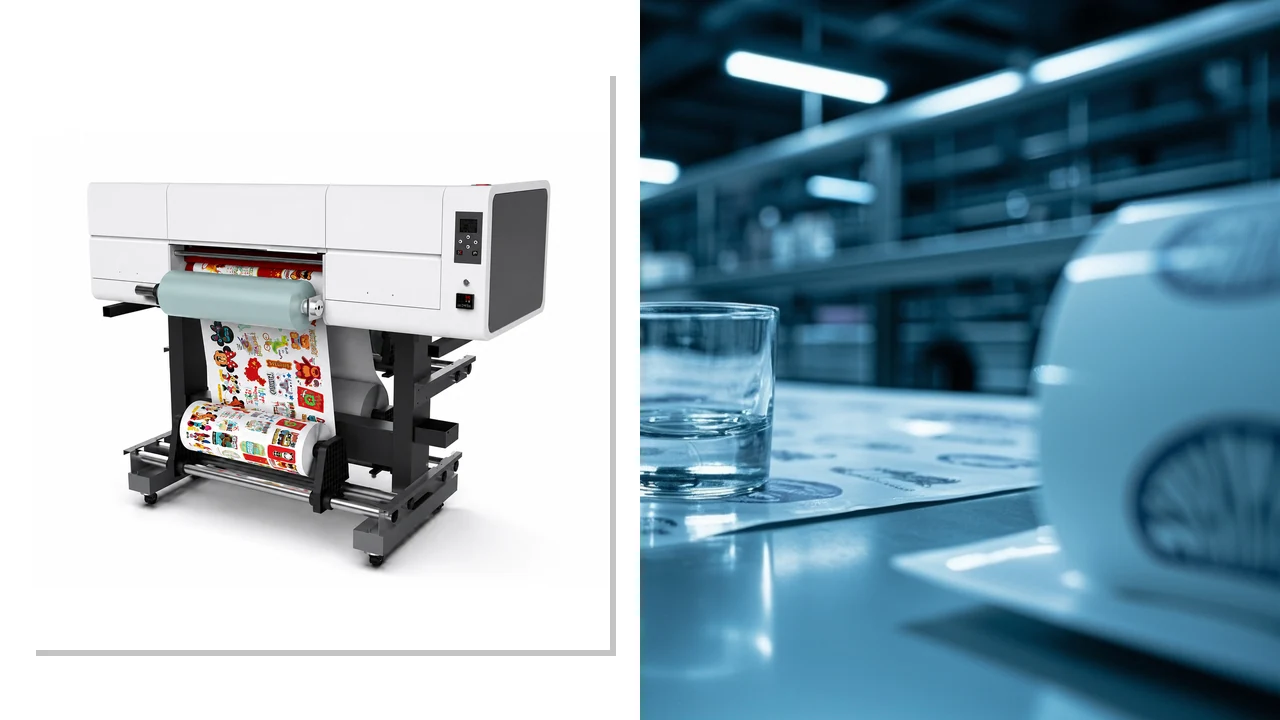
UV DTF application concept. Left: actual YOWILL UDTF-620 Industrial product image. Right: AI-generated application scene.
Dimension 1: Process Mechanics
UV DTF stands for UV Direct to Film. The process is digital printing onto AB film. The workflow is: print CMYK plus white plus varnish onto A film (release film) under UV lamp cure, laminate with B film (adhesive film), press onto the target substrate, peel away A film and the artwork stays on the surface. The dimensional depth and gloss come from the varnish layer thickness — that’s where the “crystal label” name originates.
Screen printing is an analog plate-making process. The workflow is: use photosensitive emulsion to create a screen plate (one per color), press the plate against the substrate, drag a squeegee to push ink through the mesh openings onto the substrate, then cure the ink into a film. A multi-color artwork needs several plates layered precisely.
The core difference in one sentence: UV DTF is digital printing (one piece minimum, unlimited artwork); screen printing is analog plate-making (one screen per artwork).
The visual difference is more obvious. UV DTF crystal labels have a dimensional embossed feel, transparent gloss and 3D depth; screen printed labels are flat solid color with thick ink layers.
Verdict: Process mechanics drive all the downstream differences — cost, minimum order quantity, durability all derive from here.
Dimension 2: Minimum Order Quantity and Cost Structure
Screen printing cost splits into three buckets: plate fees, ink and labor. Plate fees are fixed, USD 7-30 per screen depending on precision and size, so a minimum run is required to amortize. Ink and labor scale linearly with quantity.
UV DTF cost is different. No plate fees, but you pay AB film consumables (USD 0.7-2 per sheet), ink (charged by area or printhead depreciation), varnish and transfer labor. Per-piece cost is insensitive to quantity — running one piece or a thousand pieces costs about the same in consumables.
The math produces several cost crossover points.
Below 50 pieces, UV DTF wins decisively. Screen printing plate costs dominate the per-piece price and make small batches uncompetitive. UV DTF has zero plate cost and only charges consumables, so the entry cost is clearly lower.
Between 50 and 500 pieces, UV DTF per-piece cost exceeds screen printing, but customers pay a premium for the dimensional finish. This is the psychological price band — the dimensional premium on UV DTF crystal labels covers the process cost gap.
Above 1000 pieces, screen printing per-piece cost pulls back ahead. Ink and labor scale effects kick in at high volume and AB film consumables become the bottleneck for UV DTF.
One hidden cost is easy to miss: UV DTF equipment investment is in the five-to-six-figure USD range depending on configuration and print head selection, requiring sustained order density to amortize the equipment. If crystal label orders don’t stay full, equipment idle cost inflates the actual per-piece cost.
Verdict: Average order under 500 pieces → UV DTF. Average order over 1000 pieces → screen printing. Mid-range depends on customer willingness to pay for dimensional finish.
Dimension 3: Substrate Compatibility
UV DTF wins on cross-substrate transfer. As long as the surface can hold B film adhesion and release A film cleanly, UV DTF works. In practice the process handles ceramic, glass, metal, wood, leather, acrylic, paper, plastic, cosmetic packaging, plus curved and irregular surfaces. This makes UV DTF especially popular for gift personalization, cosmetic packaging and small-batch custom runs.
Screen printing substrate range is limited by ink type. Paper, plastic, glass, metal, fabric and leather all work, but each substrate needs its matching ink. Curved and irregular surfaces see print accuracy drop and the process usually handles only flat or gentle curves.
For high-temperature and solvent resistance, screen printing holds the advantage. Cured screen printing ink has better chemical stability and performs reliably on automotive engine covers, industrial equipment and outdoor high-heat environments. UV DTF adhesive can soften or fail under extreme heat.
For waterproof and scratch resistance, UV DTF crystal labels perform well. The varnish layer adds extra protection, and under standard test conditions multiple dishwasher cycles produce no visible peeling or fading. Screen printing waterproofing depends on the ink — standard inks wash off, and you need specialized waterproof ink.
Verdict: Irregular shapes, multi-substrate, waterproof scenarios → UV DTF. Standard flat surfaces, high volume, industrial environment → screen printing.
Dimension 4: Artwork Performance
UV DTF is digital printing at a typical resolution range of 720 to 2880 dpi depending on print head configuration — gradients, photo-quality effects, complex textures and tiny text all reproduce well. Sub-millimeter text is generally legible; the minimum readable size depends on print head precision and substrate, so verify with sample testing. Since each print can be unique, every piece in a run can carry a different design. Screen printing cannot match this.
Screen printing’s strength is spot color accuracy and large solid color areas. Screen ink can be mixed to match Pantone precisely, large solid areas come out uniform and rich, and the thick ink layer gives excellent color saturation. CMYK overprint can show visible variance from Pantone standards, so for customers with strict brand color requirements (automotive OEMs, luxury packaging), screen printing or a screen plus UV combination is more reliable.
For multi-color complex artwork, UV DTF prints in a single pass while screen printing needs multiple plates layered (one per color) and registration accuracy drops as the artwork complexity rises.
Verdict: Gradients, complex artwork, small text → UV DTF. Spot color, large solid areas, brand color → screen printing.
Dimension 5: Durability and Lifecycle
UV DTF crystal label outdoor durability varies with climate conditions, UV intensity and ink formulation; mainstream premium products typically last 2-5 years outdoors, with exact lifespan best confirmed via application-specific aging tests. Waterproof and scratch resistance depends on ink, adhesive and film. The varnish layer adds UV protection and prevents yellowing under long-term sunlight.
Screen printing label durability depends on ink choice. Standard inks fade in 1-2 years; specialty inks reach 5+ years. Screen printing’s edge is chemical stability — it outperforms UV DTF in solvent and oil exposure environments.
Edge lifting is a common UV DTF issue and depends on adhesive formulation plus transfer pressure control. Screen printing edge lifting depends on ink adhesion, and is usually more stable than UV DTF.
Under UV exposure, UV DTF performs well (varnish protection); standard screen printing ink yellows (you need UV-resistant ink).
Verdict: Outdoor, long-term use, frequent touch → quality UV DTF. Temporary, one-time use, indoor → screen printing.
The two processes divide the workload, not replace each other. UV DTF holds a unique position in small batches, personalization, dimensional finish and cross-substrate scenarios; screen printing remains the workhorse for large batches, spot color, flat surfaces and industrial environments. Pick the dominant process by order structure and keep the other as a complement — that is the most stable approach.
For UV DTF equipment and crystal label samples, see the UDTF-320 Pro entry-level model (desktop or floor option) and the UDTF-620 Industrial professional model. Contact YOWILL sales for configuration and pricing.
Frequently Asked Questions
How do I choose between UV DTF crystal labels and screen printed labels?
Choose by order structure. Below 500 pieces per order with personalization and dimensional finish, UV DTF wins. Above 1000 pieces requiring tight spot color and cost efficiency, screen printing wins. Mid-range orders depend on customer priorities.
What substrates work with UV DTF?
Ceramic, glass, metal, wood, leather, acrylic, paper, plastic and cosmetic packaging all work. Curved and irregular surfaces also stick. The key is B film adhesion plus clean A film release.
What is the minimum order quantity for UV DTF labels?
UV DTF has zero plate cost, so theoretically one piece. In practice AB film blanking has a minimum run of 10-50 sheets per batch. UV DTF has a clear advantage for small batches.
Are UV DTF crystal labels waterproof and dishwasher safe?
Generally yes. Premium UV DTF labels pass multiple dishwasher cycles under standard test conditions; the exact cycle count depends on ink, adhesive and film formulation. The varnish layer adds waterproof protection. Under extreme heat or strong acids and bases the adhesive may degrade; the exact temperature threshold depends on the adhesive formulation, so request sample data from your supplier and verify in your application.
How much does a UV DTF printer cost?
Entry-level UDTF-320 Pro is available in desktop or floor model, with prices depending on print head configuration. The professional UDTF-620 Industrial supports wider format and higher throughput. Contact YOWILL sales for current pricing.
Can UV DTF crystal labels fully replace screen printed labels?
No. The two processes divide the workload, not replace each other. Screen printing still wins for spot color accuracy, large batches and industrial environments. UV DTF is built for small batches, personalization and dimensional finish.
5 steps to decide if your label orders fit UV DTF or screen printing
- Tally the average order size and largest single-run quantity from your last 3 months
- List the typical customer requirements for artwork complexity (gradient, spot color, text size)
- List the substrate mix (curved, flat, irregular, outdoor)
- Compare UV DTF and screen printing hidden costs (equipment depreciation, AB film consumption, ink amortization)
- Pick the dominant process by order structure and keep the other as a complement
Share this article