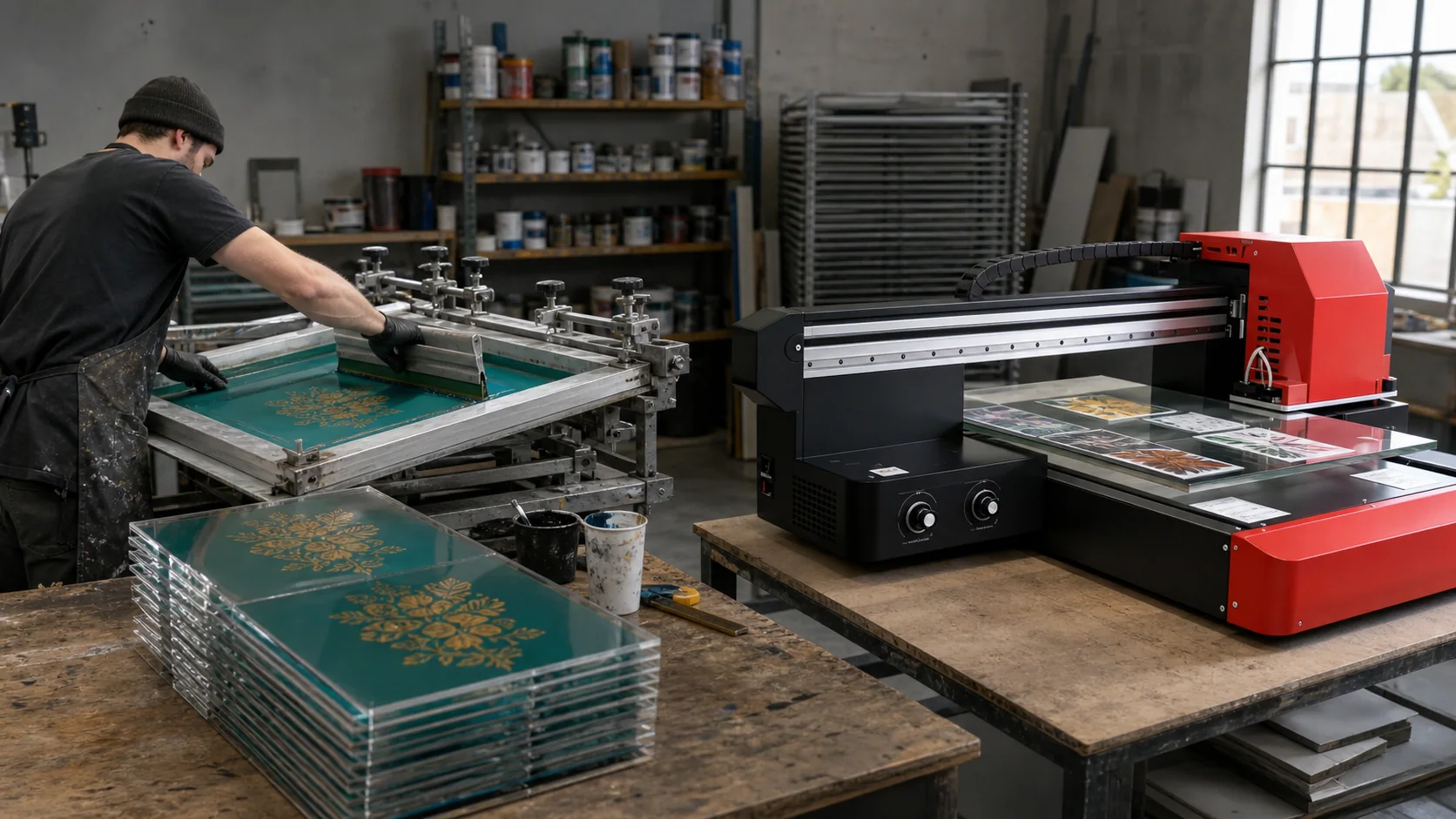
Almost everyone in the printing industry faces this choice: UV digital printing or traditional screen printing? This isn’t a question of “one replacing the other” — each process has its own territory, and choosing wrong means losing control of costs.
This article compares them across five core dimensions to help you determine which process suits your business better.
Dimension 1: What Is the Minimum Order Quantity Threshold?
This is the most critical difference.
Screen Printing: Plate-making costs require a certain minimum order volume to amortize. A set of screen printing plates costs between 50-200 RMB (depending on precision and size), which means:
- For orders under 50 pieces, plate-making costs dominate
- Below 100 pieces, per-unit pricing is largely uncompetitive
- Above 500 pieces, screen printing’s per-unit cost advantage truly emerges
UV Printing: Zero plate-making cost, print from one piece up. The per-unit cost difference between the first piece and the thousandth is only in material amortization.
Verdict: If your average order size is 200 pieces or fewer, UV printing has an absolute cost advantage. The larger the order volume, the more screen printing pulls ahead.
Dimension 2: Color Performance
Screen Printing’s strength lies in spot color printing — it can mix very precise Pantone colors, and large solid color areas come out uniform and rich. Screen printing deposits a thicker ink layer with excellent color saturation, especially suited for:
- Large block solid-color patterns
- Brand-specific Pantone color identifiers
- Scenarios requiring heavy ink coverage
UV Printing’s strength is in gradients and complex patterns. Digital printing achieves 720x2160 dpi resolution or higher — photo-quality gradients, tiny text, and intricate textures are all well within reach.
However, UV printing is limited in spot color accuracy. Colors produced by CMYK process printing may have a perceptible difference from Pantone standard colors. If your clients have strict brand color standards (e.g., automotive, luxury packaging), screen printing or a combined screen + UV approach is more reliable.
Verdict: Complex patterns, gradients, photo quality -> UV printing. Accurate spot colors, large solid areas -> screen printing.
Dimension 3: Material Compatibility
Screen printing can theoretically print on any material, but in practice, switching materials requires adjusting ink formulations and drying parameters. Moving from paper to plastic needs changes; from plastic to metal requires yet another setup. Skilled screen printing technicians are highly valued because much of the process expertise resides in the operator.
UV Printing’s material adaptability is its core selling point. UV ink cures instantly under ultraviolet light without relying on material absorption, so it can print directly on:
- Acrylic
- Metal (aluminum alloy, stainless steel, copper)
- Glass
- Leather
- Ceramic tile
- Wood
- Plastic (ABS, PC, PVC, acrylic)
- Stone
No pretreatment is needed (some materials may require simple cleaning), no special inks required, no parameter adjustments (excluding height calibration).
Verdict: If your clients demand a variety of materials, each in small quantities, UV printing is the only viable solution.
Dimension 4: Delivery Lead Time
| Stage | Screen Printing | UV Printing |
|---|---|---|
| Plate-making / Setup | 1-3 days | 0 (drag and drop file) |
| Proofing / Approval | 1-2 days (requires plate-making) | Instant (print one to confirm) |
| Production run | Fast (tens per minute) | Slower (depends on resolution) |
| Reorder / Revision | Requires new plates | Edit and print immediately |
Key Difference: Rush Orders
UV printing can achieve “send file in the morning, ship in the afternoon.” Screen printing, from plate-making to setup to approval, takes at least 2 days at best.
If your clients frequently need next-day delivery, UV printing is the only option.
Dimension 5: Total Cost Model
Here is a simplified but realistic cost comparison model. Assume an order for 100x100mm acrylic signs with four-color artwork:
| Cost Item | Screen Printing | UV Printing |
|---|---|---|
| Plate-making | 120 RMB (4 colors x 30 RMB) | 0 RMB |
| Setup waste | 50 RMB (test prints and materials) | 10 RMB (first-piece calibration) |
| Material per piece | 3 RMB | 5 RMB |
| Labor per piece | 2 RMB | 1 RMB (higher automation) |
| Speed | 500 pcs/hour | 40-60 pcs/hour |
Per-Unit Cost at Different Order Volumes:
| Order Qty | Screen (per pc) | UV (per pc) | Better Option |
|---|---|---|---|
| 10 pcs | 22.00 RMB | 6.40 RMB | UV Printing |
| 50 pcs | 6.40 RMB | 6.08 RMB | UV Printing (slightly better) |
| 100 pcs | 4.70 RMB | 6.04 RMB | Screen Printing (slightly better) |
| 500 pcs | 3.34 RMB | 6.01 RMB | Screen Printing |
| 1000 pcs | 3.17 RMB | 6.00 RMB | Screen Printing |
The break-even point is between 60-80 pieces. Below this volume, UV printing costs less; above it, screen printing has the advantage.
However, screen printing’s cost advantage assumes “one run to completion.” If your 1000-piece order is delivered in 5 batches, each requiring new plate-making and setup, costs rise substantially.
Bonus: They Are Not Mutually Exclusive
In practice, more and more businesses are adopting a “UV + Screen Printing” hybrid approach:
- Base layers with screen printing: Large white base coats done in one pass with screen printing — efficient and low cost
- Color artwork with UV: Color portions printed with UV digital printing for high precision and rich detail
- Varnish effects with UV: Spot varnish or embossed effects are only achievable with UV printing
Some YOWILL customers operate exactly this model — one screen printing machine for high-volume base layers, one UV printer for small-batch color and custom orders. The two machines don’t compete; they expand the range of orders you can take.
Decision Framework
If your business fits these characteristics, prioritize UV printing:
- Average order size of 200 pieces or fewer
- Customer requirements change frequently (design, size, material)
- Next-day or 48-hour delivery is common
- Multiple material types involved (acrylic, metal, plastic mixed)
- Personalization/customization needed (different artwork per piece)
If your business fits these characteristics, screen printing is still the better choice:
- Long-term stable, high-volume production of a single product
- Strict Pantone color matching requirements
- Large solid-color area printing
- Access to experienced screen printing technicians
If you have characteristics from both, consider a hybrid approach, or look into UV DTF transfer technology — it combines UV printing’s flexibility with close-to-screen-printing batch efficiency.
Related Guides
- How to Choose a UV Printhead — Critical printhead options when UV print precision matters
- UV Printer Maintenance Checklist — Choosing UV means factoring maintenance cost into daily operations
Frequently Asked Questions
How do I choose between UV printing and screen printing?
Pick by your average order size and design complexity. Below 200 pieces per order with variable artwork (gradients, photos, complex textures), UV printing wins. Above 500 pieces requiring tight Pantone color matching or large solid areas, screen printing wins. Mid-range orders depend on customer preference for lead time vs minimum order.
What is the minimum order quantity threshold for screen printing?
Screen plate fees run USD 7-30 per set, so orders below 50 pieces have a prohibitive plate-cost share and uncompetitive unit pricing. The screen-printing cost advantage really kicks in around 500+ pieces — this is the key cost crossover with UV printing.
Can UV printing fully replace screen printing?
No. UV printing is limited on spot-color accuracy — CMYK overprint can show visible variance from Pantone standards. For customers with strict brand color requirements (auto OEMs, luxury packaging), screen printing or a screen+UV combination is more reliable.
Are UV printing consumable costs higher than screen printing?
UV printing has zero plate cost, but consumables (ink, printhead depreciation, varnish) charge per piece or per area. Screen printing consumes mainly ink and plate amortization. For high volume batches where unit cost dominates, screen printing usually wins; for small batches and personalization, UV printing has much lower entry costs.
Can UV printing and screen printing be combined?
Yes. Many real-world workflows use UV printing for full-color gradients and fine artwork, then add screen-printed spot-color logos or solid blocks on top. The two processes don't conflict — combining them often achieves the best balance of cost and visual impact.
5-step process to choose between UV printing and screen printing
- Tally the average order size and design variety from your last 3 months
- Separate customer requirements on spot color, gradient finish and minimum order
- Compare UV and screen printing per-piece cost (incl. plates, ink, labor)
- Confirm the largest part dimensions, thickness and material range
- Pick the dominant process by order structure; keep the other as a complement