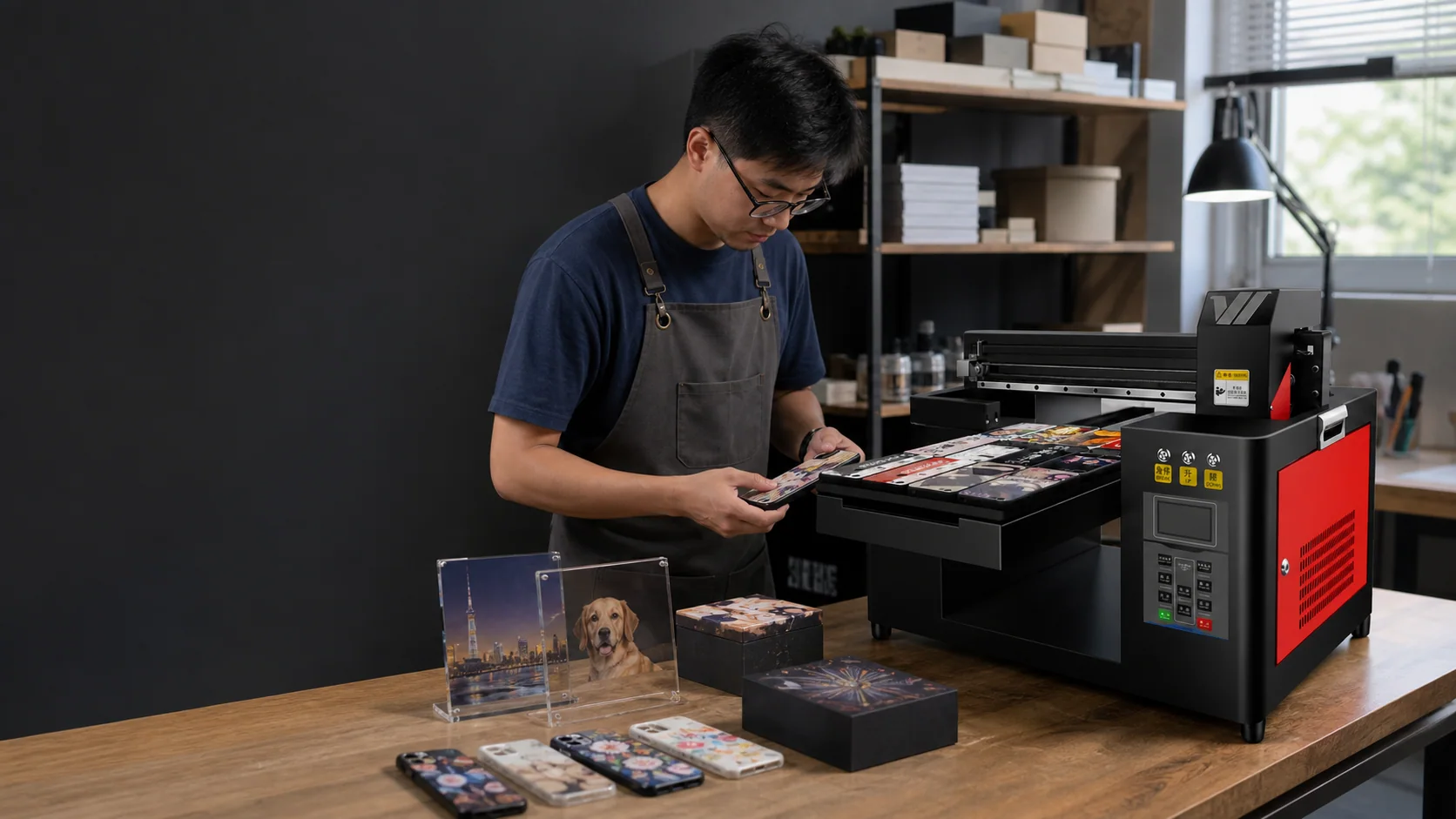
Whether a compact UV printer can support a business depends on the orders, not the machine alone. Define who will buy, what they will buy and how often before discussing equipment.
Is a UV printing business worth starting? A four-question self-check
- Will orders come from existing customers, a retail location or new customer acquisition?
- What are the main products: cases, signs, gifts or industrial samples?
- How many designs and pieces are in a typical order, and what is the required lead time?
- Who handles artwork, proofing, production, packing and after-sales service?
Without these answers, utilization and revenue cannot be estimated responsibly.
What does a UV printing business actually sell?
The business does not sell “machine output” — it sells one of three deliverable services, and the customer pays for the service rather than the print.
- On-site customization: the customer picks a design and takes the item away on the spot. Highest price per piece, but the business lives and dies on foot traffic.
- Small-batch personalization: orders from e-commerce and social channels, minimums from a few pieces to a few dozen, with the customer uploading artwork. Driven by traffic and conversion rate.
- Sampling and small production runs: samples and repeat runs for ad agencies and gift factories. Small volume, but the referral stream is steady.
Acquisition method, price point and repeat-purchase logic differ across the three. Mixing them into one payback model is the most common way to overestimate revenue — the classic error is applying store-traffic assumptions to online orders.
Which orders are most profitable? Start with per-piece margin
The same A3 machine produces very different outcomes depending on the order mix. Take phone-case customization, the most common entry category, running 10 orders per day on an A3 small-format machine:
| Line item | Figure |
|---|---|
| Retail price per piece | USD 7-11 (50-80 RMB) |
| Material and consumables | about USD 1.50-2 (10-15 RMB) |
| Per-piece margin | about USD 6-9 (40-65 RMB) |
| Daily margin | about USD 55-83 (400-600 RMB) |
| Monthly margin (22 days) | about USD 1,220-1,830 (8,800-13,200 RMB) |
Phone cases are the typical entry category: high margin, no repeated artwork, good for ramping volume. The catch is a low price point and repeat purchase driven by price competition — when order volume dips, fixed costs eat the margin immediately. Signs, nameplates and acrylic pieces carry much higher prices, but customers only pay a customization premium if the job is right the first time. Acrylic work depends on white-ink layering, print thickness and print-cut registration, and getting those wrong means heavy rework (material behaviour is covered in UV printer for acrylic).
Whether an order is worth taking comes down to per-piece margin x quantity minus rework, not the order total.
How to model the payback period of a UV printing business
Build your own order model:
Order contribution = sales revenue - blank products - ink and consumables - packing and shipping - platform fees - rework - labor time
Then include rent, marketing, depreciation, maintenance and working capital as fixed costs. Payback depends on contribution per order, order frequency and utilization. It cannot be inferred from the machine price alone.
Which machine tier fits which monthly volume?
Machine tier and order volume are bound together: oversize and you are tying up capital in idle equipment, undersize and you turn orders away every week.
| Machine tier | Typical monthly volume | Retail price per piece | Equipment investment |
|---|---|---|---|
| A4 desktop | under 200 small pieces | USD 5-25 | Several thousand RMB |
| A3 / small format | 500-2,000 mid-size pieces | USD 8-50 | 10,000-30,000 RMB (about USD 1,400-4,200) |
| Mid-format | 1,000+ pieces per SKU, incl. panels up to 500mm | per piece or per area | 30,000-80,000 RMB (USD 4,200-11,000) |
| Industrial | mass production | priced by area | 80,000 RMB+ (USD 11,000+) |
If volume stays under 200 pieces a month, an A4 desktop unit is enough — do not step up to mid-format on the expectation of “growing later”. Once volume settles at 500-2,000 pieces and you need to cover parts with a 200-300mm long edge, the A3 small-format class is where price-to-performance concentrates. Move to mid-format when a single SKU passes 1,000 pieces a month and you need to extend from small gift items to panels up to 500mm — dual printheads add roughly 70-90% throughput over a single head, and only at that point does it pay for itself.
The four mistakes that cost beginners money
- Back-calculating payback from the machine price. Payback depends on per-order contribution; the machine is only one fixed cost. With the same equipment one operator breaks even in three months and another is still underwater after a year and a half. The difference is order structure, not the quote.
- Ignoring the customer acquisition window. Without an existing customer channel, the first 3-6 months are pure acquisition. Model cash flow at zero revenue for that period, not at full-load margin.
- Not counting rework and scrap. Ink, primer, rejected parts and reprinted samples are real money. This is the line new operators underestimate most — one failed surface prep can scrap a whole batch.
- Testing materials after buying the machine. Printhead, ink, primer and substrate are a matched set. Sample on the real substrate before buying equipment; doing it the other way round, the machine is the most expensive mistake.
Which orders suit a compact printer?
- Parts stay within the bed size, height and fixture space.
- Orders combine many designs with short quantities or personalized data.
- Customers value fast delivery, low minimums or customization.
- The business already has a customer channel, such as a sign shop, gift store or online shop.
For long runs of one design, compare screen printing, pad printing and outsourcing as well. For a full comparison of the two processes by order volume, see UV Printing vs Screen Printing.
Include the full production workflow
UV printing includes artwork checks, fixture setup, surface cleaning, possible primer, nozzle tests, color approval, finishing, packing and rework. Substrate formulations can change adhesion even when the product name is the same.
Test three to five real products and record labor time, material use and pass rate at each step. This pilot is more useful than a generic profit table.
Maintenance time belongs in that labor cost. UV printer maintenance follows a fixed rhythm: about 5 minutes before startup and after shutdown each day, about 20 minutes a week for deeper cleaning and ink-path checks, 30-40 minutes a month for full inspection and component servicing, and 1-2 hours per quarter. At 5 minutes a day that is more than 30 hours a year of non-production time — the first thing new operators forget to count.
Consumables are not shelf-stable either: unopened UV ink typically lasts 6-12 months, and once opened it should be used within 3-6 months, stored away from light between 15-28°C. Over-ordering means real money ends up in the bin.
Pre-purchase validation checklist
- Sample-test the actual substrate.
- Confirm maximum part size, thickness and fixture clearance.
- Record cycle time in the intended quality mode, not only headline speed.
- Review white-ink circulation, capping, cleaning and daily maintenance.
- Confirm training, consumables, spare parts and remote support.
- Use a conservative order forecast and include acquisition and rework costs.
The first 90 days
| Phase | What to do | Pass criteria |
|---|---|---|
| Days 1-30 | Do not buy equipment yet. Sample on an existing machine or a supplier’s, lock in 3-5 real products and record time, material use and rework rate for each | Per-piece margin is positive on at least 3 products |
| Days 31-60 | Take small-batch orders through the customer channel you already have, and collect formal equipment and consumable quotes from 2-3 suppliers | Rework rate is stable and contribution per order is repeatable |
| Days 61-90 | Review actual volume and only then pick the machine tier and configuration | Volume holds at the target tier for two consecutive months |
The order matters: validate orders first, validate the process second, buy the machine last. Run it in the other order and the most expensive thing you own is the machine nobody uses.
Conclusion
Compact UV printing fits mixed-design, short-run work that requires fast response. Validate the customer and product first, the process second and the machine last. YOWILL can arrange sample testing and configuration guidance based on the substrate, size, target finish and daily output.
Related Guides
- UV Printer Buying Guide: Choose by Material, Size and Output — Once the business direction is clear, how to pick the machine
- How to Choose UV Ink: Material, Flexibility and Adhesion — Fine details on consumables and material matching
- UV Printer for Acrylic: Print Settings, Materials and Common Failures — What acrylic orders look like in production once the order mix is settled
Frequently Asked Questions
How many orders per day can a small UV printing business handle?
Real throughput is set by your order mix, not the machine's rated speed. An A3-class small-format machine running 10 phone-case orders per day yields roughly USD 1,220-1,830 monthly margin; 3-5 larger orders (signs, acrylic customization) can match that margin.
Can I start a UV printing business with no existing customer base?
Yes, but include the customer acquisition window in your payback model. The safest entry is to attach UV printing to an existing channel — print shop, gift shop, e-commerce store — then consider an independent storefront or pure online acquisition after 3-6 months.
Does UV printing or screen printing pay back faster?
UV printing pays back faster below ~200 pieces per order — zero plate cost, small-batch pricing wins. Screen printing's per-piece cost catches up and overtakes UV around 500+ pieces.
How many staff does a small UV printing business need?
One person can start, but per-person output caps the business. The most practical setup is two — one handling design, sampling and customer communication; the other running the machine, finishing and packaging. Add a full-time operator once orders stabilize.
How high are UV printing consumable costs?
Ink is the main consumable. An A3-class machine running one phone case costs about USD 1.50-2 in ink and supplies; per-piece margin typically lands at USD 6-9. Printhead depreciation spread over 12-18 months is roughly tens of cents per piece.
Share this article